
How to Prepare for a Job Interview and Become the Obvious Choice
By Victoria Lioznyansky, M.S., M.A. | Updated: April 19, 2026
In a market where everyone looks good on paper, the candidate who gets hired is the one who shows up with clarity, conviction, and the kind of quiet authority that makes it unmistakably clear — this is your seat.
Let me ask you something honestly.
When was the last time you walked out of a job interview and thought:
I showed them exactly who I am and what I bring to the table.
Not just that you answered the questions. Not just that you “did well enough.” But that you were fully seen.
For most people, that almost never happens.
Instead, they walk out replaying everything they didn’t say. The example that would have made their experience obvious. The accomplishment they never found space for. The answer that felt slightly incomplete the moment it left their mouth.
And underneath all of that, there is usually a quieter realization:
I know I was one of the strongest candidates… but I don’t think they saw it.
That gap between who you are and how you show up in that moment is not a talent problem.
It is not a confidence problem in the way most people think about it.
It is a visibility problem.
And in today’s market, that gap is costing people real opportunities, often without them even realizing why.

Hi, I’m Victoria Lioznyansky, a TEDx speaker, leadership presence and public speaking confidence coach, and founder of Brilliant Speakers Academy®. I help senior professionals and leaders communicate with calm authority under pressure, without faking confidence, relying on performance tricks, or pretending to be someone they’re not.
Why Job Interviews Are More Competitive Than Ever
We are operating in one of the most competitive hiring environments in recent years.
Mass layoffs across industries have flooded the market with highly qualified candidates. Entire teams of experienced professionals are now competing for the same roles. Remote work has expanded hiring beyond geography, which means you are no longer competing with ten people in your city. You are competing with hundreds of people across the country, sometimes across the world.
And then there is AI.
AI has fundamentally changed the front end of the hiring process.
Anyone can now produce:
- a polished resume
- a strong cover letter
- a compelling LinkedIn profile
The written version of you has never been easier to optimize.
Which means it has never been less differentiating.
You can take an average candidate and make them look exceptional on paper. You can refine language, structure achievements, and present a clean narrative.
But that advantage disappears the moment you enter the interview.
Because written communication has become a commodity.
What cannot be replicated by AI or anything else is how you show up in the room.
Your presence. Your clarity. Your ability to think on your feet and communicate in real time.
That is where decisions are made. And that is where most people unintentionally fall short.
Why Interviewers Can’t See Your Value (Unless You Show It)
There is one truth that, once you fully internalize it, changes how you approach interviews entirely:
No one in that room knows how good you are.
They don’t know how you think. They don’t know how you solve problems under pressure. They don’t know the level of ownership you take in your work. They don’t know the judgment you’ve built over time.
They only know what you show them.
And for a long time, this is exactly where I struggled.
Not because I didn’t have the experience. But because it never felt natural to make that experience visible.
Why Being “Qualified” Isn’t Enough
Most professionals operate under an assumption that feels logical:
If I’m qualified, it will come through.
But interviews don’t work that way. Interviews are not about potential. They are about perception.
If you are thoughtful but quiet…
If you are capable but understated…
If you are experienced but not explicit…
You will be perceived as less strong than someone who communicates more clearly. Even if they are objectively less qualified.
That’s the part that frustrates people.
Because internally, they know:
“I’m stronger than that candidate.”
But externally, that difference is not visible.
The Part No One Teaches You
There is something most professionals were never taught:
Your ability to communicate your value matters just as much as the value itself.
And for many high performers, this is deeply uncomfortable.
It was for me.
I didn’t like talking about my accomplishments in a way that made me sound like the best candidate. It felt unnatural. Almost like I was pretending, like I was boasting.
So I would soften things. I would explain them neutrally. I would assume they would connect the dots.
They didn’t.
Because they can’t. They are evaluating multiple candidates. They don’t have your context. They only have what you give them.
The Hidden Layer: Anxiety
And then there is the layer most people don’t fully account for.
Even when you know what you bring, even when you’ve prepared, something shifts in the moment. Your body reacts. Your heart rate increases. Your thoughts feel less accessible. You start thinking about how you sound instead of what you’re saying.
This was a huge part of my experience.
I didn’t just struggle with interviews.
I struggled with public speaking anxiety.
So when I walked into interviews, I wasn’t just answering questions. I was managing myself.
Trying to stay composed.
Trying to not overthink.
Trying to say things the “right way.”
And that internal effort changes everything.
Because when your attention is on yourself, it is not on the conversation.
And when your attention is not on the conversation, your thinking is not as clear.
If you’ve ever felt fully prepared but still anxious in high-stakes moments like interviews, this video below will explain exactly why.

Why Referrals Felt Easier
Looking back, it makes complete sense why my first roles came through referrals.
Because in those environments:
People already knew me.
They trusted my work.
I didn’t have to prove myself from scratch.
The pressure was lower. I didn’t have to perform my value in the same way.
But eventually, that changed. And I had to start interviewing in rooms where no one knew me. Where everything depended on how I showed up in that moment.
What Changed Everything
The real shift wasn’t learning better answers.
It was removing what was interfering with my ability to communicate.
Once I addressed the anxiety, everything changed. I could think clearly while speaking. I could stay present. I could access what I knew.
And that changed how I showed up.
I wasn’t trying to impress. I wasn’t trying to perform. I was just communicating.
And from that point on, I received an offer for every role I interviewed for.
Not because I became someone different. But because I finally showed up as who I already was.
The Problem with How Most People Prepare for an Interview
Most interview preparation focuses on content. Questions. Answers. Scripts.
But the real problem isn’t what you say. It’s how you show up when you say it.
Because preparation happens in a calm environment. And interviews happen under pressure.
And those are two very different states.
How to Prepare for a Job Interview That Actually Works: Step-by-Step
This is where preparation shifts from surface-level to strategic.
Because the goal is no longer: “Answer questions well.”
The goal becomes: “Make it unmistakably clear that I am the right person for this role.”
And that requires a different kind of preparation, that I outline below.
FREE GUIDE
We respect your inbox. No spam. Unsubscribe anytime.
Step 1: Build Your Inventory of Excellence
Before you think about interview questions, you need clarity.
Not vague confidence. Not general self-belief. Actual, specific clarity.
You need to sit down and answer, in detail:
Why should they hire me?
Not based on what you think they want to hear. Not only based on the job description. Based on reality.
What do you actually bring?
Most people skip this step entirely. Or they rush through it. Or they stay surface-level.
They write things like:
- “Strong communicator”
- “Team player”
- “Hard worker”
And none of that helps them in the interview. Because those are labels. And labels don’t translate into conviction.
You need depth.
You need to map out:
- What you are genuinely exceptional at
- How you approach problems
- What people consistently rely on you for
- What differentiates you in a meaningful way
Because if you are not clear on your own value, you cannot communicate it clearly to someone else.
And this was a major shift for me.
Before I did this work, I had a general sense of what I was good at. But I couldn’t articulate it cleanly.
Which meant that in interviews, I would speak in a way that felt… diluted.
Once I got clear, truly clear, everything became easier to express.
Step 2: Turn Each Strength Into a Story
This is where most candidates fall short.
They know what they are good at. But when they speak, they stay at the level of description.
“I’m a strong communicator.”
“I’m good with stakeholders.”
“I’m a strategic thinker.”
And the problem is: Every candidate says that. So it carries no weight.
What makes you memorable is specificity. For every strength in your inventory, you need a real example. A moment. A situation. Something that actually happened.
Because stories do something that statements cannot. They allow the interviewer to experience your competence.
They don’t just hear that you’re a strong leader. They see you leading. They imagine you doing that work in their organization. And that is what creates conviction.
When I started doing this differently, I noticed something shift. Instead of trying to “convince” the interviewer, I was simply showing them.
And that is a completely different experience for both sides.
Step 3: Align Your Inventory With the Role
Now you take everything you’ve built, and you refine it. Because not everything matters equally in every interview.
Most candidates prepare broadly.
Strong candidates prepare intentionally.
You need to understand:
- What does this role actually require?
- What problems is this company trying to solve?
- What kind of person do they need in this position?
And then you ask:
- Which parts of my experience directly map to that?
- Which stories best demonstrate that?
This is not about changing your story.
It is about choosing what to highlight. Because relevance is what makes your experience land. If you bring everything, you dilute your message. If you bring the right things, you become obvious.
Step 4: Learn to Steer the Conversation
This is where the biggest shift happens.
Most candidates treat interviews like a test. They wait for questions. They answer what’s asked. And they hope it’s enough.
But interviews are not perfectly structured. The “right” question might never come.
Which means:
If you are waiting, you are leaving your outcome up to chance.
Strong candidates don’t wait. They guide. They answer the question and then expand.
They listen carefully and think:
“Is there something important they haven’t asked yet?”
And if there is, they bring it in, while "thinking on their feet". Naturally. Without forcing it.
Something as simple as:
“Something else that might be helpful to share…”
can completely change how you are perceived.
This is what allows you to ensure that your strongest points are actually seen. Because no one is responsible for showcasing your value except you.
Step 5: Make It Feel Like a Conversation
This is where everything integrates. Because at a certain point, interviews stop being about preparation. And start being about presence.
The candidates who stand out are not always the most polished. They are the most natural. The most present. The ones that build instant rapport. The easiest to talk to.
When you are deeply prepared, you stop performing. You stop trying to “get it right.” You start engaging. You listen fully. You respond in real time. You think while you speak.
And that shift is what makes you feel like a peer, not just a candidate.
I remember when this changed for me.
Interviews stopped feeling like something I had to survive. They started feeling like conversations I was part of.
And that completely changed the dynamic.
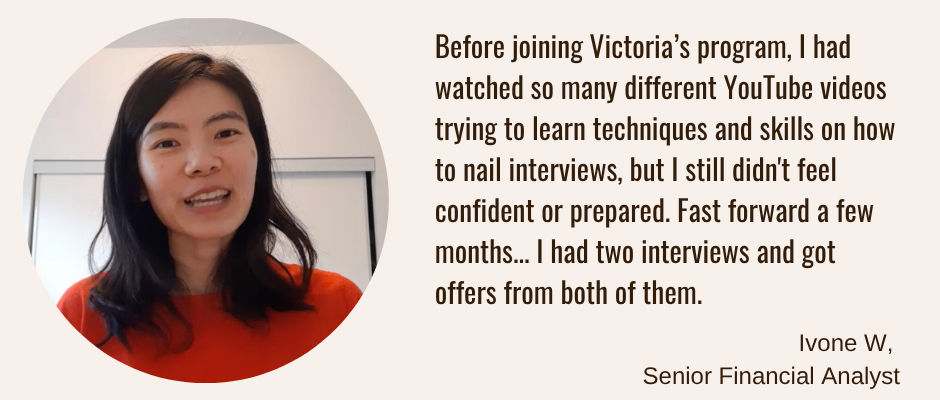
Why Interview Anxiety Affects How You Prepare and Show Up
We need to go deeper here. Because this is where most people misdiagnose the problem.
They think:
“I just need to prepare more.”
But that’s not what’s happening.
What’s happening is:
Your nervous system is reacting to visibility.
When you are in an interview, your brain can interpret it as a threat. You are being evaluated. You are being observed. There are stakes attached.
And your body responds accordingly. Heart rate increases. Breathing shifts. Thinking narrows. Access decreases.
And this is why:
You can know your material perfectly… And still blank in the moment.
This is not a knowledge issue. This is a brain under pressure issue. And no amount of preparation fixes that if the underlying response is still there. That's why preparation alone doesn't eliminate public speaking anxiety.
This is something I experienced very directly.
Before I addressed my public speaking anxiety, I could prepare extensively, and still feel like I wasn’t showing up as myself.
Because I wasn’t.
I was showing up as a version of me that was coping with nerves. And that version is always more limited.
Once that changed, everything changed.
Not because I learned new answers. But because I had access to what I already knew.
What the Obvious Choice Looks Like in the Room
This is what it looks like when everything comes together.
You walk into the interview, or join the call, and you are grounded. Not perfect. Not rehearsed. But steady.
You are not running through scripts in your head. You are present. You listen fully before responding. Because you are not rushing to perform.
You answer clearly. And then, when it makes sense, you go deeper. You bring in examples naturally. You don’t force them. You don’t over-explain. You don’t try to fill every silence. You allow your answers to land.
And if something doesn’t go perfectly? You don’t spiral. You stay with it.
Because you trust yourself.
By the end of the conversation, something important has happened.
They don’t just understand your experience. They trust it. They’ve seen how you think. They’ve seen how you respond. They’ve experienced what it would feel like to work with you.
And that is what makes the decision easy.
You Already Have What It Takes. Now Show Them.
This is something I’ve seen over and over again.
The people who struggle most with interviews are rarely the least qualified. They are often the most qualified.
They are the ones who:
Have done exceptional work quietly.
Have built deep experience over time.
Have a level of capability that is hard to capture in one conversation.
But they don’t know how to show it. They overthink. They undersell. They lose access to their thoughts under pressure. And they walk out knowing they left something important behind.
If that’s you, it’s fixable.
Not with better scripts. Not with more preparation. But with the kind of internal work that allows you to show up fully.
Because once that shift happens…
You don’t just “do better” in interviews.
You show up as someone who is clearly the right choice.
Work With Me: Interview Confidence Intensive
If you’ve ever walked out of an interview knowing you didn’t show them your full capability…
If you’ve replayed answers in your head, realizing what you should have said…
If you know you’re qualified, but that’s not consistently coming across in the room…
This is exactly the gap we close.
The Interview Confidence Intensive is designed for professionals who don’t need better answers. They need to show up as the person they already are when it matters most.
Because this isn’t about memorizing responses.
It’s about:
- thinking clearly under pressure
- communicating your value without over-explaining
- staying present instead of getting stuck in your head
- and trusting yourself in real time
So that when you walk into an interview, you’re not trying to perform. You’re simply showing them what’s already there.
What We Focus On
Inside this intensive, we work on the exact patterns that cause strong candidates to fall short in interviews:
- Overthinking and losing your train of thought
- Rambling or over-explaining to “get it right”
- Struggling to communicate your experience clearly
- Freezing or blanking under pressure
- Knowing what to say… but not being able to access it in the moment
We don’t just talk about these patterns. We shift them in real time.
What You’ll Experience
This is not passive learning. This is applied work.
You’ll receive:
- 3 private one-on-one coaching sessions (60 minutes each)
- Mock interview practice using real scenarios
- Personalized feedback on how you think and communicate under pressure
- Targeted coaching to reduce overthinking and build clarity in real time
You’ll also receive a bonus mini-training:
“How to Build Instant Rapport With Anyone”
A simple, practical approach to building trust quickly so you can feel more natural, connected, and confident in interviews.
What Changes After This Work
Clients don’t leave this intensive with better scripts.
They leave with:
- the ability to think clearly while speaking
- the confidence to trust their answers without second-guessing
- the presence to stay grounded in high-pressure conversations
- and the clarity to communicate their value in a way that actually lands
This is the difference between hoping you did well. And knowing you showed up as the obvious choice.
Enrollment
If you’re currently interviewing or preparing to… and you know that nerves, overthinking, or pressure are affecting how you show up, this intensive is for you.
For readers of this article, I’ve made a private rate available.
👉 Enroll in the Interview Confidence Intensive and receive $200 off
No pressure.
But if you’ve read this far, you already know:
This isn’t about becoming more qualified. It’s about finally showing up that way.
And that is what makes you the obvious choice.
FAQ about preparing for a job interview
How far in advance should I prepare for a job interview?
What is the best way to prepare for a job interview?
Why do I feel nervous even when I’m prepared for an interview?
How do I stop overthinking during a job interview?
How do I stand out in a job interview?
Is it better to memorize answers or speak naturally in an interview?
Can interview confidence be learned?

About Victoria Lioznyansky, M.S., M.A.
Victoria Lioznyansky is a TEDx speaker, leadership presence and public speaking confidence coach, and founder of Brilliant Speakers Academy®, where she helps senior professionals, executives, and business leaders communicate with calm authority under pressure.
After building a successful corporate career as a manager and executive and founding multiple businesses, Victoria struggled with intense public speaking anxiety herself, despite being highly capable and experienced. Traditional public speaking and communication training did not address what was really happening under pressure, which led her to develop a deeper, psychology-informed approach to confidence and communication.
Today, through Brilliant Speakers Academy®, Victoria has helped hundreds of professionals strengthen their communication, eliminate public speaking anxiety, and step fully into their leadership presence without faking confidence or trying to become someone they’re not.
In her TEDx talk “Why Practice Doesn't Cure Public Speaking Anxiety” Victoria challenges the conventional wisdom that simply practicing public speaking more will automatically build confidence and explores what can happen when we repeatedly practice speaking while anxious.
➤ Watch Victoria’s TEDx talk “Why Practice Doesn't Cure Public Speaking Anxiety”
FREE MINI-COURSE: The Speaking Confidence Kickstart
A short starter mini-course to help you understand your public speaking anxiety, discover why traditional public speaking advice has not worked for you, and begin moving toward genuine speaking confidence.
GRAB THE FREE TRAINING