
Career Skills AI Can’t Replace, And Why Public Speaking Is Your Edge Now
By Victoria Lioznyansky, M.S., M.A. | Updated: January 18, 2026
Picture this: you're in an executive meeting. Two managers are presenting their quarterly reports. Both presentations are beautifully structured, well-written, and packed with impressive data visualizations. From a technical standpoint, both are flawless.
But only one of those managers walks out with a promotion.
What made the difference?
It wasn't the numbers. It wasn't the deck. It wasn't the data.
It was how they spoke.
In an age where AI can automate tasks and analyze data instantly, the career skills AI can’t replace are more valuable than ever.
Their confidence, presence, and clarity made all the difference.
Welcome to the new workplace reality, one where AI has leveled the playing field for content creation, but elevated the value of something far more human: your ability to speak with confidence, connect with others, and show up as a leader.
This is why public speaking is no longer a "nice to have." It has become one of the top career skills AI can't replace.
I explain exactly why overcoming public speaking fear often leads to career acceleration in my podcast episode "How Overcoming Public Speaking Fear Opens Career Opportunities".
And if you want to stay competitive, visible, and promotable, you need to understand how this shift is already impacting your future.
If you want to hear how this plays out in real careers, I break it down in the video below:

AI Leveled the Playing Field... But Not the One You Think
Just a few years ago, writing skills were a huge career advantage.
Your emails, reports, presentations, they were a direct reflection of your professionalism. A polished proposal didn't just deliver information. It communicated credibility. When senior leadership read your work, the quality of your writing signaled your level of expertise and attention to detail.
People who could write well advanced faster. Those who struggled with writing often hit career ceilings, not because they lacked intelligence or capability, but because they couldn't communicate their ideas effectively on paper.
But then came ChatGPT. And Gemini. And Claude. And countless other AI tools.
Suddenly, your colleague who used to struggle with writing? They're producing immaculate reports in minutes. Junior employees are creating polished decks with ease. Even non-native English speakers can generate content that sounds like it came from a communications director.
Today, everyone has access to "good" writing instantly.
AI has flattened that playing field. The gap between average and excellent written communication has closed dramatically. What used to take hours now takes minutes. What used to distinguish you now... doesn't.
Anyone in your department can go to the same AI tool and prepare the same beautiful written report as you. That carefully crafted quarterly update you spent three hours perfecting? Your colleague generated something equally impressive in fifteen minutes.
This isn't a criticism of AI. It's simply the new reality we're navigating. AI has become the greatest equalizer in written communication. Everyone can produce professional-quality written work now. Your reports, your emails, your presentations... the written part is no longer what sets you apart.
But while writing has become easier to replicate, there's one thing AI still cannot do: speak for you.
Public Speaking Is a Career Skill AI Can't Automate
AI can help you organize your thoughts, structure your slides, even draft your speaker notes. Some advanced AI tools can even suggest tone adjustments and pacing recommendations.
But it cannot stand up in front of a room and make your audience feel something.
It can't look someone in the eye and connect. It can't adjust your tone based on the energy in the room. It can't convey empathy, humor, or conviction in the moment. It can't read nonverbal cues and pivot your message accordingly. It can't speak with the unique rhythm and presence only you have.
And that's exactly why speaking with confidence is quickly becoming one of the most future-proof career skills you can build.
When you stand up and you speak, it is still YOU. Your presence. Your energy. Your authenticity. Your ability to connect with the people in front of you, whether that's three people in a meeting or three hundred people in an auditorium.
These are profoundly human capabilities. And in a world where AI handles more and more of our routine communication, the moments when humans need to show up authentically become exponentially more valuable.
Your human presence is the new competitive advantage. And developing the career skills AI can't replace, particularly public speaking, is no longer optional for anyone serious about advancing their career.
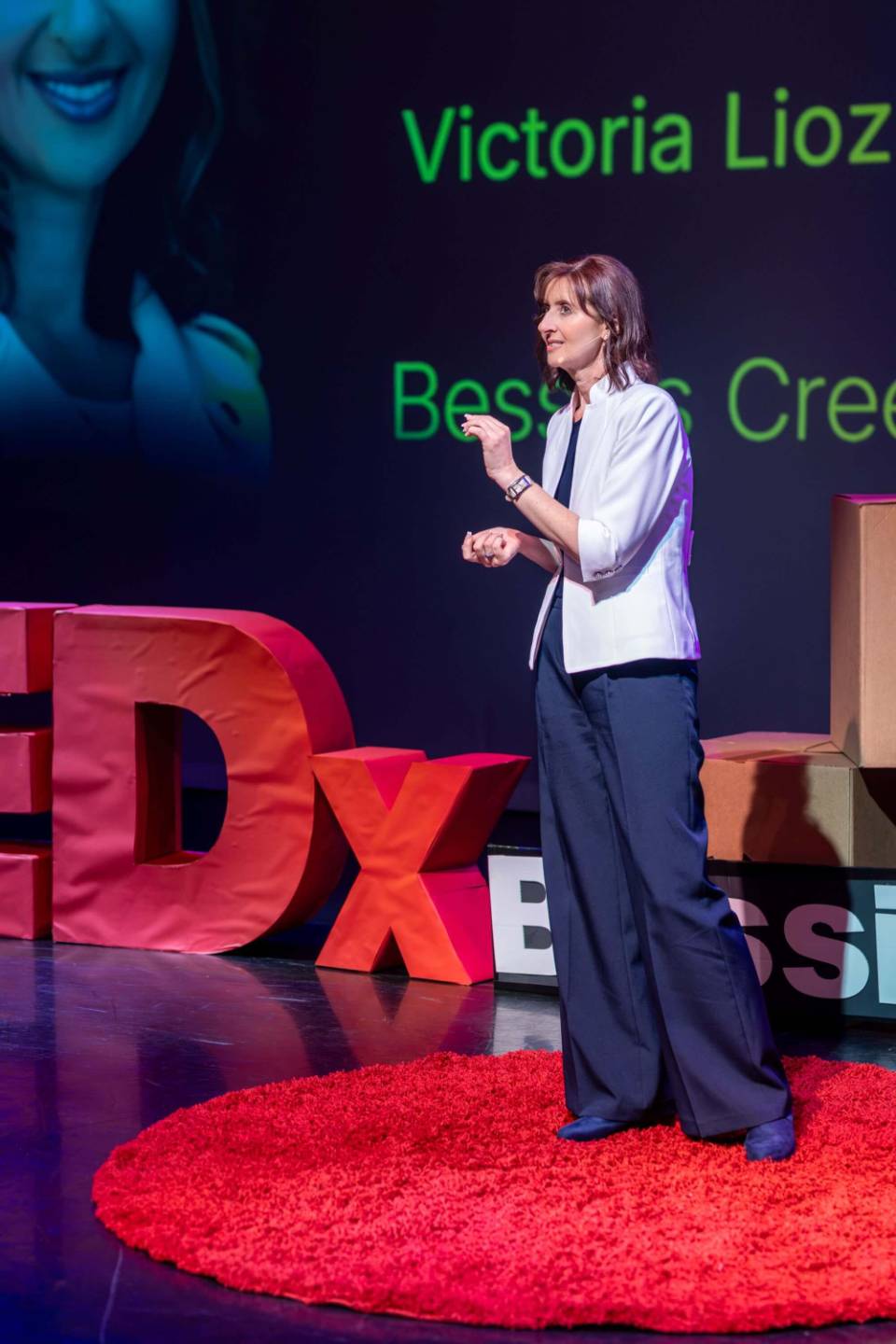
Hi, I’m Victoria Lioznyansky, a TEDx speaker, leadership presence and public speaking confidence coach, and founder of Brilliant Speakers Academy®. I help senior professionals and leaders communicate with calm authority under pressure, without faking confidence, relying on performance tricks, or pretending to be someone they’re not.
The Harsh Reality: You're Not Judged by What You Know
Here's something I tell my clients all the time: You're not perceived based on how much you know. You're perceived based on how you show up.
Let me say that again because it's so important. People don't perceive you based on your knowledge, your expertise, or even your track record. They perceive you based on how you show up.
That means how you speak in meetings. How you present your ideas. How confidently you own the room. Whether you sound like the expert you already are.
And it's not fair but it's true.
Nobody is inside your head. Nobody knows how great you are, how much you truly know. Only you do. Even when you do a terrific job, even when you deliver excellent work and everything is great, it is still perception by other people that matters.
In a world where AI-generated reports look nearly identical, the person who communicates best is the one who stands out. Not necessarily the smartest. Not always the most experienced. But the clearest. The most engaging. The most confident.
So if your voice shakes, if your mind goes blank, if you avoid eye contact or rush through your slides, that's what people remember. Not your brilliance. Not your hard work. Just how you made them feel.
This is one of the biggest unfairnesses of the work environment. But it's also why mastering career skills AI can't replace, especially public speaking, has become so critical. You can be the most knowledgeable person in the room, but if you can't communicate that knowledge effectively when all eyes are on you, someone else who speaks better will get the credit, the promotion, the opportunity.
This is how confident communication builds real authority.
FREE GUIDE
We respect your inbox. No spam. Unsubscribe anytime.
Real Talk: Why Being "Great at Your Job" Isn't Enough Anymore
Maybe you've thought: "I just need to keep proving myself. Once they see how hard I work, I'll get noticed."
Or maybe: "If I just earn one more certification, I'll feel more confident speaking up."
I hear this all the time from the professionals I work with. They think if they just become more competent, more qualified, more credentialed, then the confidence will come.
But the truth is, professional confidence doesn't automatically lead to speaking confidence.
You could be the most competent person in the room, and still panic the moment you're asked to present. You could have multiple advanced degrees, decades of experience, and an impressive track record, and still feel your confidence melt away when all eyes turn to you.
This disconnect between competence and confidence has a specific root cause, which I explain in my podcast episode "The Real Reason You're Still Struggling with Public Speaking Anxiety".
That's not because you're weak. That's not because you lack capability. It's because your brain perceives visibility as dangerous.
I know, because I lived it. For years.
I was a senior software engineer, leading teams and solving complex problems. I knew my value. I was confident in my technical abilities, genuinely confident. But the moment I had to speak up in a meeting or present to leadership?
My confidence disappeared. Completely. I felt like a fraud. I dreaded every moment in the spotlight. I would literally avoid eye contact in meetings so I wouldn't get called on. I've even walked out to use the bathroom during introductions at networking events because I didn't want to introduce myself.
Sound familiar?
This is what I call the "confidence that melts". You have it in abundance when you're just doing your work, but it vanishes the moment you're in the spotlight. And no amount of additional competence, certifications, or credentials will fix this. Because the problem isn't your expertise. The problem is how your brain perceives public speaking.
Understanding this distinction is crucial when thinking about career skills AI can't replace. Technical skills can be augmented by AI. Writing can be enhanced by AI. But the internal confidence to speak with authority? That's something you must develop yourself.
The New Professional Landscape: What Really Matters Now
Let's look at what the professional landscape looked like before AI versus what it looks like now.
Before AI: Great work plus good writing equaled success. You could hide behind emails and reports if you wanted to. Your work mostly spoke for itself. Writing skills gave you a clear edge over others.
After AI: Great work plus AI-assisted writing equals table stakes. Everyone has this now. But great work plus AI-assisted writing plus excellent speaking? That equals success. You can't hide anymore. Your work doesn't speak for itself, you must speak for it.
Why Remote Work Hasn't Changed Anything (Actually, It's Made It Harder)
Some people think, "But we work remotely now. We're on Zoom. Surely that's different?"
No. It's not different. If anything, it's harder.
Zoom presentations are everywhere. Virtual meetings haven't reduced the need for speaking skills. They've increased the demand for them. Now you need to be engaging through a screen, which is even more challenging than being engaging in person.
You're competing with every possible distraction in someone's home. Their phone. Their email. Their kids. Their pets. Other browser tabs. The temptation to multitask is enormous.
Being a compelling speaker on video requires all the skills of in-person speaking, plus the ability to project energy and presence through a camera lens. You have to work harder to connect, harder to read the room, harder to maintain engagement.
And for those of you in hybrid or in-office roles? Meetings still happen. Presentations still happen. You still need to speak up, contribute, and be visible.
Here's what I want you to understand: The higher you rise in your career, the more you must speak. Leadership equals communication. You cannot lead from behind a screen. You cannot inspire people through an email, even an AI-written one. You cannot build trust, create vision, or motivate teams without authentic human communication
Think About Your Next Role
Think about the position you want next. The role that's beyond where you are now. I guarantee you it requires more speaking, more visibility, more presence than your current role.
Does it require presenting to the board? Leading town halls? Speaking at industry conferences? Pitching to clients or investors? Running strategic meetings with senior leadership? Training and developing your team? Building alignment across departments?
Every one of these is a speaking opportunity.
And if you're not comfortable speaking with authority, you'll either avoid these moments, underperform when they arise, or stay stuck while others get the visibility and promotions.
This is why public speaking is now one of the top career skills AI can't replace. It's not supplemental. It's not a bonus. It's essential for anyone who wants to advance into leadership.
What You Don't Need to Do (Common Myths Holding You Back)
Let me clear up a few myths that might be holding you back, because I hear these all the time from professionals trying to develop this crucial skill.
Myth #1: You need to memorize your entire talk
Memorization actually increases pressure. If one word goes missing, your brain can panic. You lose your place, you can't get back, and suddenly you're in a full-blown anxiety spiral. Instead, learn to structure your ideas with anchor points that let you speak naturally. You want to know your content inside and out, but you don't want to memorize it word-for-word.
Myth #2: You need to "fake it till you make it"
Your audience can sense when you're performing. When you're trying to be someone you're not, when you're projecting confidence you don't actually feel, people pick up on that inauthenticity. True presence comes from inner safety and genuine confidence, not outer performance. Faking it doesn't work long-term, and it certainly doesn't address the root cause of your anxiety.
Myth #3: You need to keep "practicing through the fear"
This is probably the most damaging advice out there. Practice doesn't make perfect, it makes permanent. If you keep practicing while anxious, you're reinforcing anxiety, not confidence. You're building a habit of feeling anxious every time you speak. I've worked with clients who have been "practicing" for 30 or 40 years, and they come to me still anxious because they've spent decades reinforcing the wrong habit.
Myth #4: You need to be naturally charismatic or extroverted
Public speaking isn't about being the loudest or most outgoing person in the room. Some of the most powerful speakers are introverts. You don't need to change your personality. You need to be the most grounded, authentic version of yourself. That's what creates real connection and impact.
What Actually Works: Developing Career Skills AI Can't Replace
So what does work? What actually changes things when it comes to building public speaking confidence, one of the most valuable career skills AI can't replace?
Retraining your brain to see visibility as safe
Your nervous system needs to stop seeing an audience as a threat. Right now, for those of us who experience public speaking anxiety, our brain perceives public speaking situations as dangerous. Your brain sees that audience the same way it would see a physical threat.
So it sends you fear signals — sweaty palms, racing heart, foggy brain, shaky knees — to warn you. It's trying to protect you. But this can be changed. Yes, even if you've struggled with speaking for years or decades.
The only way to stop experiencing those fear signals is to retrain your brain to stop seeing public speaking as a threat. This is internal work that addresses the root cause, not just the symptoms.
Rewriting the stories you tell yourself
Limiting beliefs like "I'm not a good speaker" or "I'm not charismatic" are just that, beliefs. Not facts. But we've told them to ourselves so many times that they feel like facts.
We all have these limiting beliefs about ourselves. Stories we've been telling ourselves for years, maybe decades. Overcoming public speaking anxiety requires identifying these limiting beliefs and transforming them into empowering beliefs.
Nobody can make you believe something about yourself that you don't already believe about yourself. If someone tells you you're not a good speaker and that belief sticks, it's because somewhere inside, you already believed it. The work is identifying those beliefs and changing them.
Building speaking confidence from within
This is the confidence that doesn't melt under pressure. The kind you can feel in your bones, even when all eyes are on you.
You need to build what I call "speaking confidence", and it's different from professional confidence. You can have all the professional confidence in the world and still lack speaking confidence. This needs to be built on top of who you already are, so you can walk into any room and be yourself. Not a fake version of yourself. Not someone you think you should be. Just you, but the best, most confident version of you.
This is what makes public speaking one of the most valuable career skills AI can't replace. Because AI can help you prepare, but only you can develop this internal confidence. Only you can do the work of changing how you think, how you feel, and how your brain perceives the entire experience of speaking.
The Time Investment That Changes Everything
Here's what my clients typically experience when they commit to developing this skill:
Within 2-3 weeks of working together, they start seeing changes. Small at first, but noticeable. They feel slightly more at ease in meetings. They speak up once when they normally wouldn't have. Their internal dialogue starts shifting.
Within 2-3 months, the changes become significant. They're no longer experiencing that massive fear before presentations. They might still feel some butterflies, but not the paralyzing anxiety that used to grip them.
Within 3-4 months, they're volunteering for speaking opportunities they would have run from before. They're actually excited about visibility. They understand that being seen is how they grow their careers.
One of my clients was 53 when he started working with me. His job required him to give presentations, and he was miserable. He hated his job. Four months later, he was getting standing ovations. He got promoted to a position where he now flies all over the country giving presentations and training leaders. At 58, he told me, "This is my dream job. I can't believe this is my life now."
This is what's possible when you address the root cause of your anxiety and build genuine confidence from the inside out. This is what happens when you commit to developing one of the most important career skills AI can't replace.
The Opportunity Ahead: Your Irreplaceable Advantage
You have a choice.
You can let AI take over more and more of your communication until your presence becomes optional. Until you become interchangeable with anyone else who has access to the same tools.
Or you can lean into the one thing that makes you irreplaceable: your voice.
The leaders of tomorrow won't be the ones who write the best reports or create the most polished decks. AI is already doing that. The leaders of tomorrow will be the ones who can communicate with confidence in any room, with any audience, under any pressure.
They'll be the ones who can connect authentically. Who can read a room and adjust in real time. Who can inspire and influence through their presence. Who can make people feel something that moves them to action.
These are the career skills AI can't replace. These are the skills that will determine who rises to the top in the next decade of work.
Most people will continue struggling with this. Most people will avoid it, hoping it goes away or that they can succeed without it. But you know the truth: in a world where AI does the writing, speaking is your competitive advantage.
This is the moment to invest in the one skill that AI will never replicate. The one skill that becomes more valuable as everything else becomes easier to automate.
Ready to Become the Speaker Your Career Needs You to Be?
If you're tired of avoiding the spotlight or if you know deep down that your visibility is the missing link in your success, let's talk.
I offer personalized coaching for corporate professionals, leaders, and experts who are ready to finally overcome public speaking anxiety and build unshakable confidence from the inside out.
Because here's what I know about you: You didn't randomly find this article. You're here because you know something needs to change. You know that your fear of public speaking is holding you back. You know you're capable of more. You know you have value to contribute. You're just tired of your confidence melting away the moment you need it most.
The question isn't whether you'll need this skill. The question is: when will you decide to master it?
Schedule your free strategy call with me.
We'll uncover what's holding you back, map out your goals, and create a clear plan to get you from anxious to authority.
Because you deserve to walk into any room, step onto any stage, join any meeting, and feel like yourself. Your best self. Confident, capable, and ready to make the impact only you can make.
The AI revolution has made one thing crystal clear: your voice matters more than ever. The only question is whether you're ready to use it.

About Victoria Lioznyansky, M.S., M.A.
Victoria Lioznyansky is a TEDx speaker, leadership presence and public speaking confidence coach, and founder of Brilliant Speakers Academy®, where she helps senior professionals, executives, and business leaders communicate with calm authority under pressure.
After building a successful corporate career as a manager and executive and founding multiple businesses, Victoria struggled with intense public speaking anxiety herself, despite being highly capable and experienced. Traditional public speaking and communication training did not address what was really happening under pressure, which led her to develop a deeper, psychology-informed approach to confidence and communication.
Today, through Brilliant Speakers Academy®, Victoria has helped hundreds of professionals strengthen their communication, eliminate public speaking anxiety, and step fully into their leadership presence without faking confidence or trying to become someone they’re not.
In her TEDx talk “Why Practice Doesn't Cure Public Speaking Anxiety” Victoria challenges the conventional wisdom that simply practicing public speaking more will automatically build confidence and explores what can happen when we repeatedly practice speaking while anxious.
➤ Watch Victoria’s TEDx talk “Why Practice Doesn't Cure Public Speaking Anxiety”
FREE MINI-COURSE: The Speaking Confidence Kickstart
A short starter mini-course to help you understand your public speaking anxiety, discover why traditional public speaking advice has not worked for you, and begin moving toward genuine speaking confidence.
GRAB THE FREE TRAINING